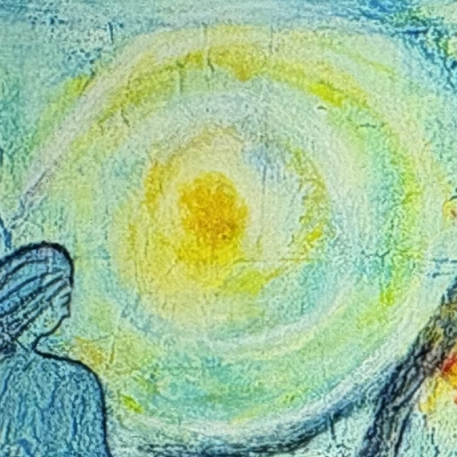

“…protective power is always and ever present within the sanctuary of the heart…” Joseph Campbell
If you had the chance to read my first post, The Mask and The Journey, you may know something I deeply believe: our children may learn to wear masks to survive adverse circumstances within their families post-separation and divorce. What I did not share is that they also carry small physical items that offer emotional comfort and help them get through tough times. A mask hides what a child feels. A stuffed animal, clutched in their small hands during a hard goodbye, may carry their feelings. Both are symbols a child builds to hold something that is just too big for words.
Recently, someone loaned me their copy of the April 2020 edition of the Family Court Review, which included two works by Dr. Benjamin Garber, a psychologist in New Hampshire. One of them was “Dynamics, Not Diagnosis.” In it, Garber writes that attachment theory presents a model we might emulate. What I take him to mean is that the more useful question is what is happening between people, and not what label we put on them. I wanted to read more of his work, so I searched online and found a law review article he wrote with Dana Prescott, titled “On the Value of Teddy Bears and Barbie Dolls: The Place of Children’s Transitional Objects in Family Law.”
Prescott is a lawyer, social worker, and rostered guardian ad litem in southern Maine. I mention this because so much of what I read about families like mine was written elsewhere, by people elsewhere. This one was written, in part, by someone right here.
I felt a bit triggered reading through it, and grateful, too. I am not a lawyer or a judge, only a Maine mom with lived experience. But I recognized things in that article. Two professionals were describing, in careful and unemotional language, something I had lived through and had never once come across anyone writing down
Young children often and naturally attach to a favorite thing, such as a teddy bear, toy, or blanket, for comfort, especially during separations. The object is just an object, yet it is one that a child holds especially dear. Joseph Campbell, in “The Hero With A Thousand Faces,” writes about protective figures who offer special amulets meant to safeguard their carriers. Is not a favorite thing, such as a doll or teddy bear, a special amulet that provides a child with similar security? What turns an object into something contested is when one parent decides that it represents the other parent and reacts accordingly. The child was only ever comforting themselves.
What the paper shares
The authors of the referenced paper describe two court cases. In one, a toddler-aged girl loved a small stuffed animal, and her mother encouraged her to carry it between homes to make transitions easier. The father took it away from her again and again, and then began leaving it in his car trunk enough that it came back with a terrible odor. In the other case, a toddler-aged girl’s doll was discarded under a carport. In both cases, the judges saw something much larger inside the acts, a comfort object destroyed or discarded by a parent who had decided it meant something it was never meant to mean.
The authors wrote thoughtfully about the importance of transitional objects in the paper, and yet I felt that it landed on themes consistently found in “parental alienation.” A parent who prohibits, damages, demeans, or discards a child’s beloved object is showing “a selfish, controlling, and even alienating behavior directly counter to the best interests of the child.” Some clinicians call it alienation-by-proxy, which is described as when one parent’s “hatred of another is extended to otherwise benign objects by association…”
The object is neutral. It becomes a target only because one parent decides it stands in for the other parent and destroys or discards it.
Where I see the experts in this
Dr Craig Childress describes how, in alienating post-separation family situations, one parent damages a child’s attachment and bonding system, and the felt connection to the other parent, a good-enough and loving parent, and may frame it as child protection. Destroying a child’s comfort object is rarely about the object. It is the parents’ need to control and erase the other parent’s presence, and it can even be projected onto small things.
Another expert, Jennifer Harman’s research, found that a parent’s alienating behaviors map onto the Duluth Power and Control Wheel used to describe coercively controlling abuse, describing alienation as that same control continuing after separation. A stuffed animal that is thrown into a car trunk stops looking like an isolated bad action. It appears like a small part of a larger, recognizable pattern.
Beyond Transitional Things
A comfort object can be an old favorite sweater that smells like home, a necklace, or a tattered blanket. It can also be a living creature. A family dog or cat is a beloved pet, nothing more complicated than that, until a parent decides the animal is in some way associated with the child’s other parent, and makes it disappear, rarely framed as cruelty, but rather as practicality. A missing stuffed animal can be replaced. A missing beloved pet cannot, and I think many parents get that. The authors of the paper describe, too, “it is not gender or biology which defines the power to act insensitively toward a child’s [object or pet] attachments but the intentionality of the act itself by that person with such power.”
I know this one from the inside. Shortly after my divorce, my ex-husband got rid of our daughter’s beloved pet. As I recall it, her pet had never once been a problem before I left. It became a regular one afterward. Our daughter was highly distressed when her pet was taken away, and I still have drawings she made in the aftermath, her way, I feel, of expressing a grief and helplessness she did not yet have the language for. I felt then and still feel it was a cruel thing to do to a child whose world was already in upheaval. I am describing what I think happened in my own family and what it felt like to me. I am not labeling or diagnosing anyone.
Pets are not a footnote. Researchers and advocates who work within the domestic abuse and intimate partner violence space have well documented that animals can be used as leverage, or worse, harmed. The National Coalition Against Domestic Violence offers a brochure on this topic. Pets may be threatened, withheld, rehomed, or made to disappear, precisely because the harm lands on the target or someone they love. When a child’s pet vanishes after a separation, it’s worth asking who the loss was meant for.
The Gifts
The Garber and Prescott article also reminds me that gifts from the targeted parent carry the giver’s name, too. I think the same pattern applies when they are destroyed, discarded, given away, or even returned, not necessarily because the child needed or wanted them gone, but because the parent holding them decided what they meant. I recall a time after the holiday season a few years back when my ex returned not one or some, but all of several gifts I purchased for our daughter, and took for himself a gift card for the refund amount. Some months later, when I discovered the returns for a gift card on my account order history, I asked him about it and demanded the money back. Thankfully, he did give it back to me.
There is a subtler version of gift aversion, too. Some experts describe how it can take the shape of a silent stone face, an eye roll, or a gasp when a gift comes up. There may be jokes or sarcastic comments made within a child’s earshot about how a gift is cheap, dumb, or inferior. A child may absorb that liking things from the other parent is not approved, good, or safe. It does the same work as pulling a toy from small hands, without ever touching it.
I want to add something else. In more severe cases, according to experts, it may not always be the controlling parent’s hand doing the discarding. A more strongly alienated child may be the one who destroys or discards a gift, sometimes with genuine anger. I believe this is Campbell’s mask hard at work again, doing what it was designed to do. A child caught in this bind may have learned that holding onto something from the targeted parent carries a cost. Underneath their mask of self-protection, they learn lessons by watching what happens to the things they want and love.
Some teenagers may never admit that having a “piece of a parent” still matters, but one may keep photos of that parent, a special piece of jewelry, or a half-forgotten, worn-out Teddy bear tucked away in a drawer. Whether or not a child has any conscious wish to feel close to that parent, the object still sits there and can still become a flashpoint the moment someone else decides it means something else.
If you are the child who found this
I write for other targeted parents, but I know this site sometimes finds its way to the eyes of a teenager or a young adult searching for meaning and understanding. If that is you, please do know there is nothing wrong with you for keeping something small tucked away, and there is nothing wrong with you if you felt you had to get rid of it yourself. Whatever you did with it, you did it to survive something that was never your fault. You are allowed to love both of your parents, even if it feels or felt unsafe to say it out loud. There is nothing bad or wrong about needing to protect yourself.
Why this matters
This post was inspired by Garber and Prescott’s important paper published in the law journal, and it reminded me of some things I experienced within my own family. This post is about how one parent sometimes treats small, ordinary things and a child’s beloved pet. A parent who lets a blanket just be a blanket is showing you their capacity to put their child and their needs first. A parent who decides it must mean something, and destroys or discards it for that reason, is showing you something, too.
With heartfelt care,
A Maine mom
Read the law journal paper here:
Garber, Benjamin D. and Prescott, Dana E. “On the Value of Teddy Bears and Barbie Dolls: The Place of Children’s Transitional Objects in Family Law.” Southwestern Law Review 189 (2020).
This reflects my own reading and understanding, as a mother, of the paper above, alongside my reading and understanding, as a mother, of the works of Childress and Harman. I am a Maine mom with lived experience, not a clinical or legal professional.


Leave a Reply